Kramers-Protected Error Correction With Andreev Spin Qubits
Kramers-protected error correction with Andreev spin qubits
Haoran Lu, Isidora Araya Day, Anton R. Akhmerov, Bernard van Heck, Valla Fatemi
June 9th 2026


Spin
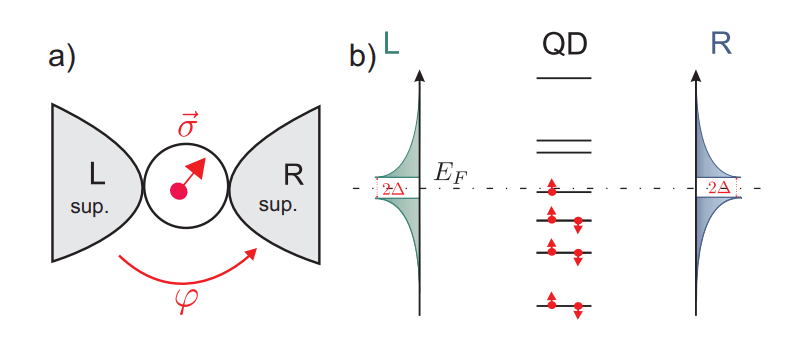
Spin Qubit
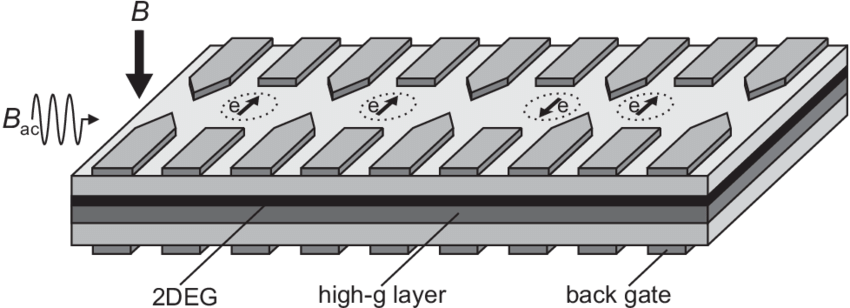
Andreev Bound State
\[ U_{\sigma} = E_J \cos(\varphi) \]
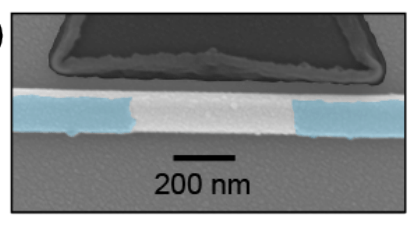
Spin degenerate bound state!
Max Hays PhD thesis, 2021
Andreev Bound State + Spin Orbit
\[ U_{\sigma} = E_J \cos(\varphi) + E_{\sigma}(\vec{\epsilon}_{SO}\cdot \vec{\sigma})\sin(\varphi) \]
Superconducting Spin Qubits, C. Padurariu & Y. Nazarov, 2009
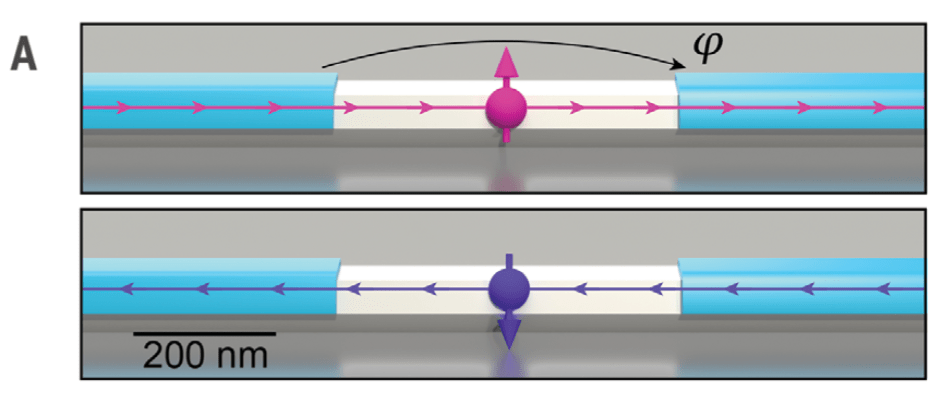
Andreev Spin Qubit
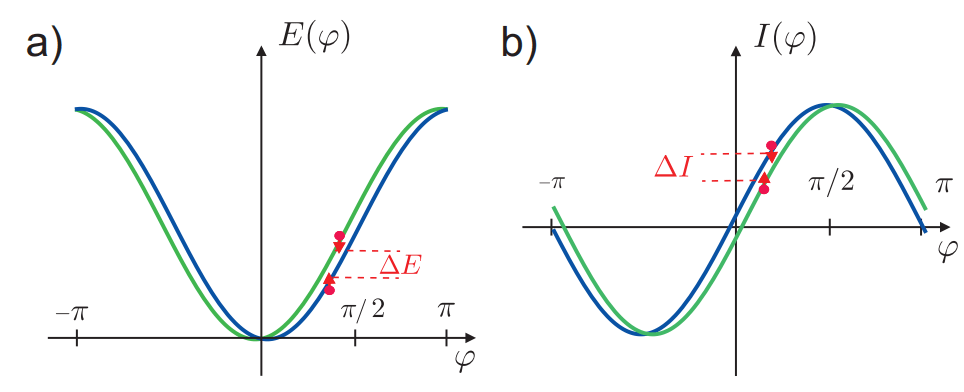
\[ \propto \frac{dE(\varphi)}{d\varphi} \]
Spin degree of freedom couples to supercurrent!
Andreev Spin Qubit Readout
\[\lvert 0\rangle\]
\[\lvert 1\rangle\]
Spin degree of freedom couples to supercurrent!
Thus, if we can measure supercurrent, we can do readout.
Coherent manipulation of an Andreev spin qubit, M. Hays et al. 2021
Inductance Couples To The ASQ Ground State
\[ E_L \propto \frac{1}{L} \propto \frac{d^2E(\varphi)}{d\varphi^2} \]
We can infer the ASQ state by measuring its inductance.
Andreev Spin Qubit Coupled To A Transmon
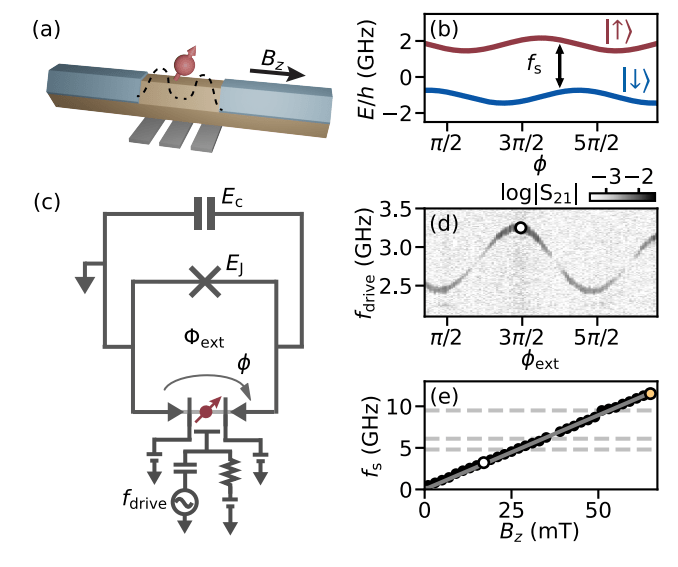

- Superconducting phase couples the 2 elements
- It allows readout of ASQ via transmon
Direct manipulation of a superconducting spin qubit strongly coupled to a transmon qubit, M. Pita-Vidal et al. 2022
Kramers’ Theorem At TRS Flux
At fluxes \(\varphi = 0,\pi\), the eigenstates of the Hamiltonian are degenerate.
Therefore, we need a magnetic field or a drive to implement gates.
Design: ASQ In A Network Of Inductors
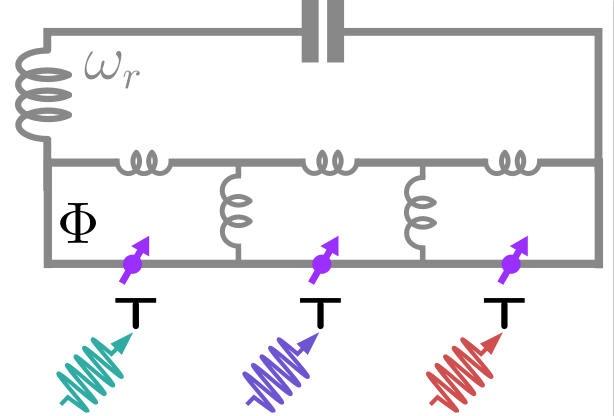
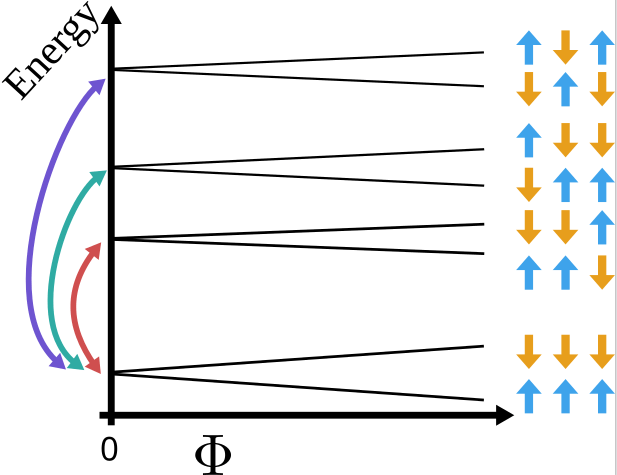
\[ \lvert 1_L\rangle,\quad \lvert 0_L\rangle \]
\[ H_{\sigma} = J_{12}\sigma_{1,z}\sigma_{2,z} + J_{23}\sigma_{2,z}\sigma_{3,z} + J_{13}\sigma_{1,z}\sigma_{3,z} \]
Kramers theorem forces a degenerate computational space at TRS flux.
Dispersive Readout Via Network Inductance
\[ H_{\sigma} = J_{12}\sigma_{1,z}\sigma_{2,z} + J_{23}\sigma_{2,z}\sigma_{3,z} + J_{13}\sigma_{1,z}\sigma_{3,z} \]
\[ H_r = \hbar\omega_{r,0}a^\dagger a + \sum_{i\neq j}\hbar\chi_{ij}\sigma_{i,z}\sigma_{j,z}a^\dagger a \]
A single readout resonator detects bit flips.
Dispersive Readout Via Network Inductance
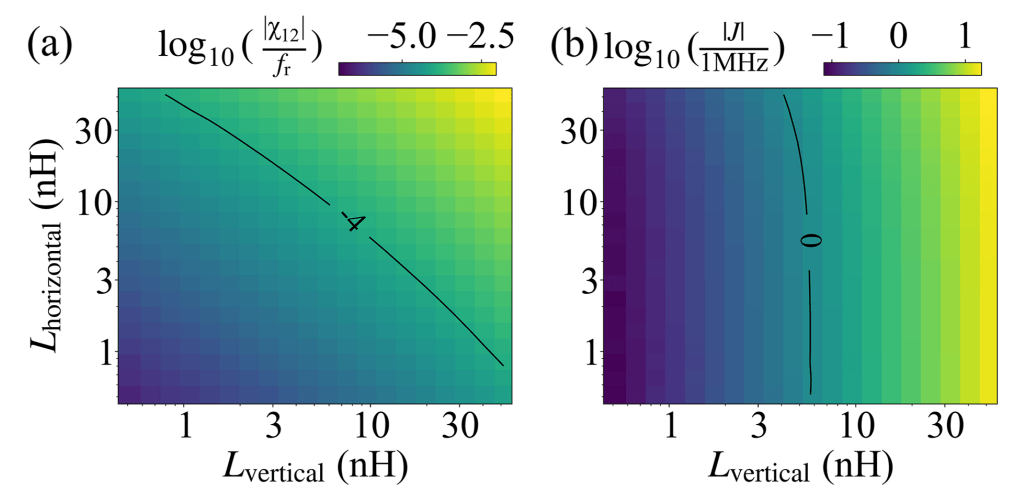
\[ H_{\sigma} = J_{12}\sigma_{1,z}\sigma_{2,z} + J_{23}\sigma_{2,z}\sigma_{3,z} + J_{13}\sigma_{1,z}\sigma_{3,z} \]
\[ H_r = \hbar\omega_{r,0}a^\dagger a + \sum_{i\neq j}\hbar\chi_{ij}\sigma_{i,z}\sigma_{j,z}a^\dagger a \]
Conclusions
- Proof of principle of repetition error-correcting code with ASQ
- Materials with which to make the junctions remain a challenge